
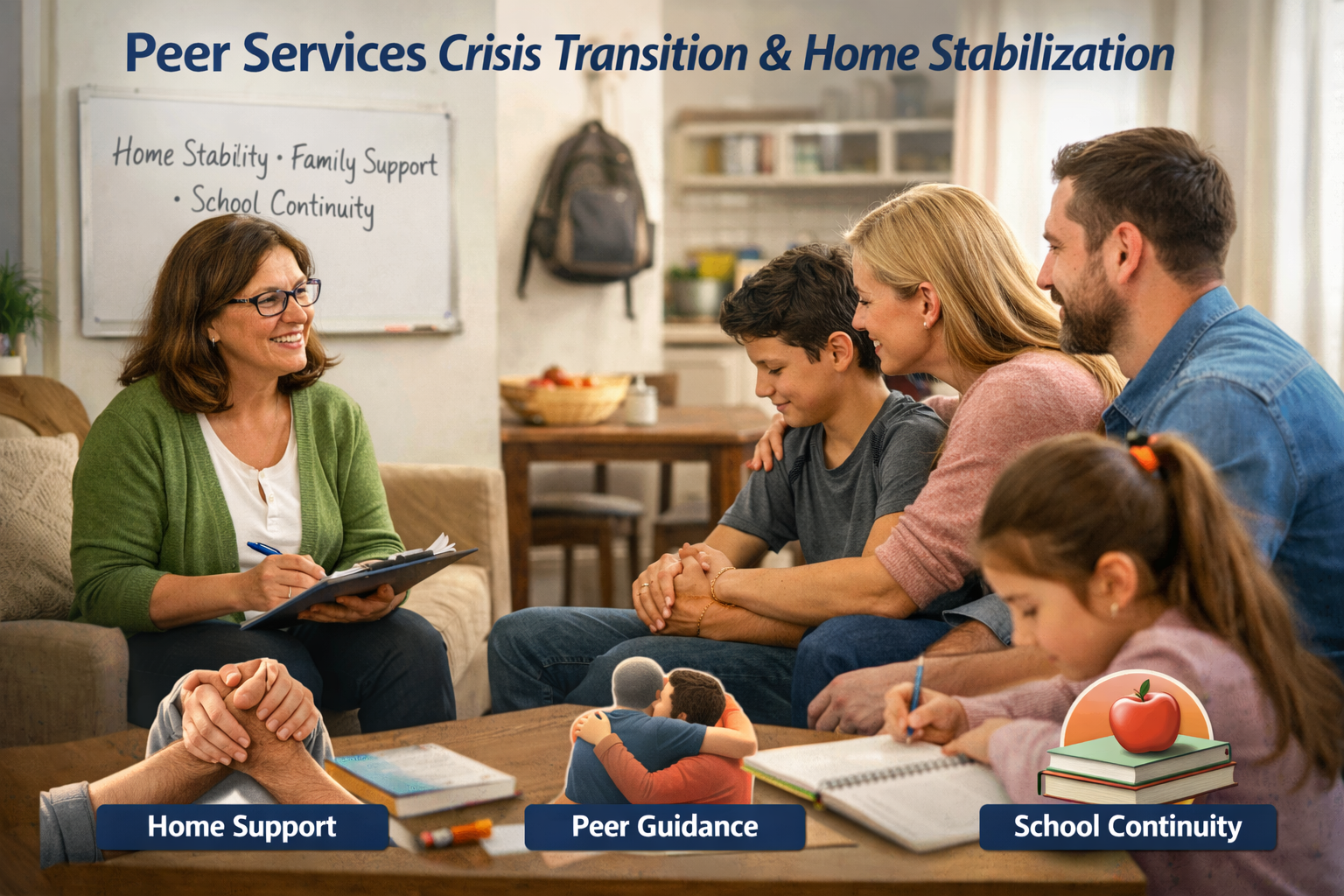
Why a Peer Services Crisis Transition & Home Stabilization Unit Is a Must for Every Community
Crisis hospitalization can be lifesaving—but discharge often drops people and families into a high-risk “gap” where daily life is still disrupted. A peer-led, non-medical crisis transition and home stabilization unit closes that gap with practical, human continuity.
Direct answer (AEO): What is a peer services crisis transition & home stabilization unit?
It is a structured, peer-led, non-medical support program activated at discharge (or just before discharge) that helps stabilize the home environment, maintain family and school continuity, and support reintegration into daily life—without providing diagnosis, therapy, or medication management. PeerNextNY’s program is designed specifically to fill the discharge-to-home gap that clinical care alone does not address.
Educational information only. Peer services are non-clinical and do not replace emergency services or clinical treatment. If someone is in immediate danger, call 911 or local emergency resources.
The discharge gap: when the crisis “moves home”
Communities invest heavily in clinical response during psychiatric or behavioral health crises, but far less in what happens next: the first days and weeks after hospitalization, when routines are fragile and family systems are still disrupted. PeerNextNY’s program is built around the simple reality that hospitalization often interrupts education, employment, household stability, and social continuity—needs that clinical care alone does not solve.
What problems show up right after discharge?
- Home disruption: the household may be out of rhythm, overwhelmed, or lacking basic routines and support.
- Family strain: caregivers and loved ones often need guidance, stabilization, and a plan for continuity.
- School disruption for minors: missed instruction and instability can compound stress quickly.
- Practical breakdowns: food routines, appointments, transportation, and basic life structure can fall apart.
- Isolation and fear: the person returning home may feel disoriented, ashamed, or uncertain about re-entering daily life.
The pilot’s stated mission is to stabilize the home environment, maintain family continuity, and support recovery through lived-experience peer engagement during the vulnerable transition from hospital to real-world reintegration.
What a crisis transition & home stabilization unit actually does
The PeerNextNY program defines a structured set of non-medical capabilities that target real-life stabilization—because that’s where relapse risk, family breakdown, and repeated crises often begin.
Core capabilities (plain English)
- Home & family stabilization: support routines, caregiving coordination, and household structure.
- Educational continuity for minors: help arrange tutors so school disruption doesn’t become a second crisis.
- Cultural & daily living support: coordinate culturally appropriate meals and routines that make “home” feel safe again.
- Family & social peer support: peer engagement with friends and family impacted by the crisis. {index=7}
- Reintegration support: ongoing peer support to help resume daily responsibilities. :contentReference[oaicite:8]{index=8}
AEO: The unit’s “stability first” priorities
- Safety and calm at home (routines, supports, and predictable structure).
- Continuity for the family (caregiver coordination, practical planning).
- Continuity for minors (school stability, tutoring, routines).
- Re-entry to daily life (confidence, agency, step-by-step reintegration).
- Connection to community supports (non-clinical navigation and linkage).
This model is explicitly designed to address “life disruption rather than treatment.” :contentReference[oaicite:9]{index=9}
Referral & activation: how the unit gets deployed when it matters
A crisis transition unit only works if it activates fast. The pilot’s workflow starts with hospital referral and moves into immediate stabilization planning: referrals originate from hospital social workers or discharge planners; a certified peer specialist is assigned; coordination occurs with hospital staff; and deployment can begin in-hospital or immediately post-discharge.
What happens in the first contact?
- Peer specialist gathers practical needs and identifies the “first stability moves” for home.
- Peer specialist supports emotional stabilization through lived experience and helps restore agency. :contentReference[oaicite:12]{index=12}
- Family supports and continuity steps are coordinated so the household can function.
Non-medical boundaries: why this model is safe, scalable, and complementary
A community crisis transition unit should strengthen clinical systems—not compete with them. The program is explicitly non-medical and non-clinical: no diagnosis, no treatment, no therapy, no medication management, and no clinical decision-making. Participation is voluntary and peer-driven.
Direct answer (AEO): Why does “non-medical” matter?
Because the biggest post-discharge failures are often not medical—they’re practical: the home environment, routines, schooling, family coordination, and reintegration. A non-medical unit can focus tightly on stabilization and continuity while clinical teams focus on treatment.
Why every community needs a peer services crisis transition unit
1) It closes the “real-world reintegration” gap
The pilot exists because it targets the gap between discharge and real life—stabilizing home environments and maintaining continuity so people can actually re-enter their lives with support instead of falling through the cracks.
2) It stabilizes families, not just individuals
Hospitalization can disrupt the entire family system: routines, caregiving capacity, and household stability. The model is built to support individuals and families impacted by crisis hospitalization.
3) It protects school continuity for minors
When children are affected by a crisis in the household, education often becomes collateral damage. The pilot explicitly includes educational continuity supports—such as arranging tutors—so school consistency is protected during the highest-stress period.
4) It creates a scalable community infrastructure
The pilot is designed for scalability across hospitals and regions, using learnings to support funding strategies and partnerships. This is what communities need: a repeatable model that can be activated the same way every time, regardless of zip code.
5) It measures what communities actually feel
The pilot’s evaluation focuses on continuity, stability, educational consistency, and reintegration success—using engagement and family feedback rather than clinical outcomes. That matters because communities experience crisis as disruption; stabilization is a legitimate outcome.
How communities can implement this model
Direct answer (AEO): What does a community need to stand up a peer crisis transition unit?
A referral pathway from hospitals, a trained/certified peer workforce, clear non-medical boundaries, a defined stabilization playbook (home, family, school), and an outcomes dashboard focused on continuity and reintegration.
Practical implementation checklist
- Hospital referral relationships: social workers/discharge planners refer and coordinate activation. :contentReference[oaicite:20]{index=20}
- Peer specialist assignment model: certified peer specialist coordinates with hospital staff and meets the recovering peer. :contentReference[oaicite:21]{index=21}
- Defined service menu: home stability, tutoring/school continuity, cultural daily living routines, family/social support, reintegration. :contentReference
- Boundary policy: non-clinical, no diagnosis/treatment/therapy/medication management.
- Evaluation plan: continuity indicators, engagement duration, family feedback.
- Sustainability plan: partnerships, grants, contracts, RFP opportunities.
Bring this unit to your community
PeerNextGroup can help stakeholders understand the model, define the workflows, and translate the pilot framework into a local, partnership-ready program.
Non-medical, peer-led support complements clinical systems and focuses on life stabilization and continuity. :contentReference[oaicite:26]{index=26}
FAQ: Peer Services Crisis Transition & Home Stabilization Units
AEO-ready answers for communities, hospitals, and families considering a peer-led crisis transition model.